Why Good Decisions Fail: Three Questions Every School Leader Should Ask

A final decision should be preceded by mature deliberation. (Matthew Henry)
As school leaders, we make hundreds, perhaps thousands, of decisions every year. Most decisions we make are good ones. Others turn out badly.
Decisions have what I will call “decision weight.” Most are light. They are routine, often with little long-term, systemic effect on our schools. Examples include disciplining a student for a minor infraction and scheduling homecoming. Other decisions are heavy. They are consequential, complex, and sometimes controversial. Hiring and terminating employees, launching strategic initiatives or a substantial fundraising campaign, changing the curriculum in a core subject, and setting long-range budgets are examples. Such decisions are often irreversible, or difficult to reverse without high cost and controversy.
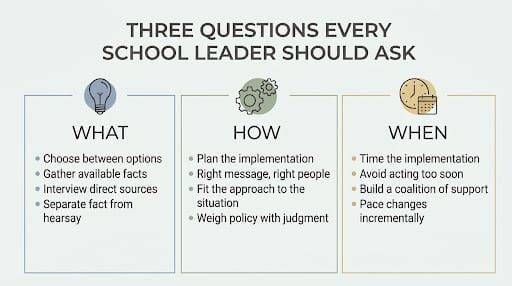
Regardless of a decision’s weight, even good decisions can fail. To increase the likelihood that a decision succeeds, you should answer three questions before making it: what should I decide, how should I implement it, and when should I act.
Q1: What
Every decision is a “what” decision. You are choosing between options. Should we launch a capital campaign, and if so, for how much? Do we need to hire another teacher? How much should compensation increase? What are the key dates for next year’s school calendar? Which option should we choose: A, B, or neither?
Good decisions begin with gathering the facts. Interview those who have direct knowledge of the issue, and ask detailed and challenging questions to separate fact from opinion, assumption, and hearsay.
An Old Testament account illustrates the danger of deciding on inadequate evidence. After the conquest of Canaan, the tribes of Reuben, Gad, and the half-tribe of Manasseh returned to their lands east of the Jordan River. They built an altar near the Jordan, which the other tribes misunderstood as rebellion against God. The western tribes gathered to make war against them, believing the altar was intended for false worship. The what was whether to go to war.
Before taking action, however, the western tribes sent Phinehas the priest and a delegation to investigate. They learned that the altar was meant as a witness and memorial of shared faith in God, not as a place for sacrifice or idolatry, and the conflict was resolved peacefully (Joshua 22:10–34). Hasty assumptions nearly led to civil war; only a thorough investigation prevented it.
I was taught early in my former corporate career never to assume: always verify before making a decision. I have had situations in which I thought I knew the facts based on what I was being told, only to discover after further investigation that things were substantially different from what I had been led to believe. Had I acted on the inaccurate information, my decisions would have been unfair to the individuals affected and would have undermined my credibility.
Be careful, prayerful, and thorough before deciding what to do.
Q2: How
Making the right decision is not enough. How it is implemented and communicated matters as well. A good decision that is poorly implemented often results in poor outcomes and can undermine trust. Poor implementation may also invite opposition and reinforce the credibility of those who opposed the decision from the outset.
Communicating the decision, the reasons for it, and the expected benefits is equally important. You must communicate the right message at the right time to only the right people. A good decision that is communicated poorly can result in inaccurate interpretations and competing narratives, and it can undermine your ability to implement the decision.
The how depends on the decision, the situation, and the weight of the matter. I recently made a disciplinary decision that affected many students and could have escalated into a crisis. The question was how to address the misbehavior of a large number of students without creating unnecessary and unhelpful conflict and controversy.
Under normal circumstances, the disciplinary policy in the Parent-Student handbook would have been applied. That would have been appropriate but unwise in this situation. The how required a more discerning approach.
After reviewing the facts with the administrators closest to the situation and consulting my leadership team, I decided to address the behavior spiritually rather than punitively. My decision differed from what others thought I should do. I communicated my decision to those who needed to know, and I met with a large group of students to address the biblical principles that applied to their behavior. The situation did not escalate into a major source of conflict within the school community, as it easily could have. Feedback from many of the students and staff who were present indicated that, by God’s grace, what I shared led the students to think more biblically about their conduct, about what it revealed about their character, about what kind of individuals they wanted to become, and about how their character should affect future behavior.
In this situation, the what was to address student misbehavior. The how was the approach and manner of addressing it, and it was more important than the what. Do not let good policies, for example those in your handbook, cause you to make a bad decision about how to apply them.
Q3: When
The third question is when to act on a decision. A good decision implemented with skill but at the wrong time can fail. You can make three mistakes when implementing a good decision: acting too soon, failing to build a coalition of support, and making too many changes in a short period of time.
Acting too soon
I have observed too many situations in which gifted school leaders create unnecessary trouble for themselves, including losing their position, because they made weighty decisions too early in their tenure. While there are situations where consequential decisions have to be made soon after accepting the head of school position, these are rare. Decisions that challenge the school’s traditions, culture, and practices, and decisions that are likely to prove controversial, should not be made until you have gained the trust and confidence of the board, staff, and school community. It takes time to build relationships and the trust that comes with them. It takes time to grasp the nuances of a school’s culture. It takes time to identify sacred cows that should not be touched, lest you find yourself sacrificed.
Good leaders can also act too hastily, regardless of tenure. This typically occurs when assumptions are made, facts are not verified, passions run hot, and pressure is applied.
I have learned over the years to slow down. Slowing down gives time for verifying facts, praying for wisdom, seeking counsel, reflecting on the best course of action, and allowing passions to cool. I have changed course numerous times as a result. In doing so, I avoided escalating an issue into a crisis that could undermine my leadership, harm others, or damage the school.
Failing to build a coalition of support
Ecclesiastes 4:9 reminds us, “Two are better than one, because they have a good reward for their toil.” You are more likely to experience success by enlisting the support of others, especially those who are respected and trusted within the school community. Take time to identify those who are likely to support your objectives and enlist their help. Also identify those who may resist.[1] While your role grants you significant authority, build a coalition of supporters who can offer wise counsel regarding the soundness of your goals, potential sources of resistance, and the most prudent path forward.
As John Kotter writes, “Because major change is so difficult to accomplish, a powerful force is required to sustain the process … A strong guiding coalition is always needed—one with the right composition, level of trust, and shared objective.”[2]
Making too many changes in a short period of time
A school culture and community can absorb only so much change. Schools are conservative organizations, and people resist change. Effective, accepted change often comes slowly. You may have identified many needed changes, but making too many consequential and potentially controversial decisions leads to stress, confusion, fear, and exhaustion. Be strategic in determining what is most needed now and what can wait. When possible, take an incremental, well-paced approach to your decision-making. Follow the BSBS principle: build slow, build solid. It takes time for the new to become the new normal. Do not rush it.
Before You Decide
Before making any decision, determine what needs to be decided, how it needs to be implemented and communicated, and when to act. Working through these questions wisely and prayerfully increases the likelihood of a good decision and of its acceptance and success. Scripture warns, “Desire without knowledge is not good, and whoever hastens with his feet misses his way” (Proverbs 19:2).
The wise leader seeks to make the right decision, to implement it the right way, to communicate it effectively, and to do so at the right time.
- Michael D. Watkins, The First 90 Days, Updated and Expanded: Proven Strategies for Getting Up to Speed Faster and Smarter (Boston: Harvard Business Review Press, 2013).
- John P. Kotter, Leading Change (Boston: Harvard Business School Press, 1996).