7 Leadership Principles from the Life of Apollos

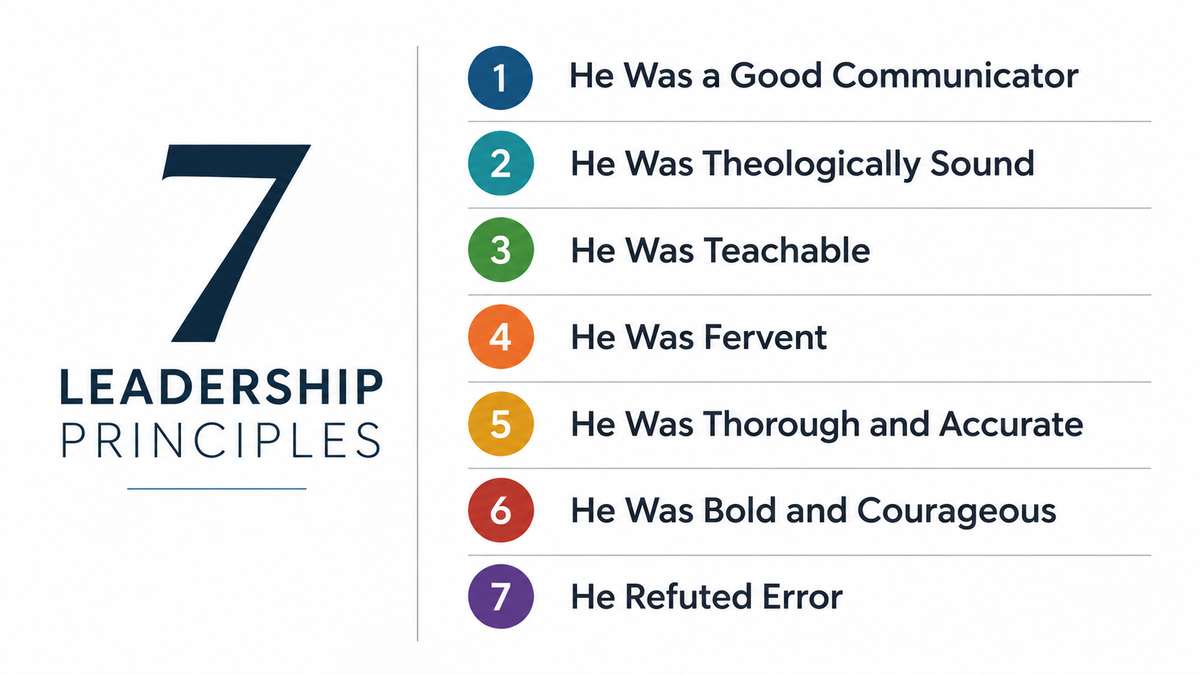
As I was reading through Acts during my morning devotional time, I paused over Luke’s description of Apollos’s character and work. Apollos is not a well-known figure in the New Testament; Luke devotes only five verses to him. Yet within them lies a portrait of fruitful leadership. As I reflected on this passage, I found seven principles in Apollos’s leadership worth cultivating in our own.
24 Now a Jew named Apollos, a native of Alexandria, came to Ephesus. He was an eloquent man, competent in the Scriptures. 25 He had been instructed in the way of the Lord. And being fervent in spirit, he spoke and taught accurately the things concerning Jesus, though he knew only the baptism of John. 26 He began to speak boldly in the synagogue, but when Priscilla and Aquila heard him, they took him aside and explained to him the way of God more accurately. 27 And when he wished to cross to Achaia, the brothers encouraged him and wrote to the disciples to welcome him. When he arrived, he greatly helped those who through grace had believed, 28 for he powerfully refuted the Jews in public, showing by the Scriptures that the Christ was Jesus. (Acts 18:24–28)
1. He Was a Good Communicator
He was an eloquent man … (Acts 18:24).
Christian school leaders wear many hats, and few roles matter more than that of "Communicator in Chief." We share our school’s mission and values. We explain biblical truth and how it is to shape people, programs, and policies. We promote the school’s mission, vision, and value proposition. We speak to groups and meet with parents, staff, students, donors, community leaders, and the media. We speak into conflict and controversy. We are constantly communicating, both in person and in writing.
The quality of our communication is important, though it does not require the eloquence of an Apollos. Paul apparently lacked eloquence: "Even if I am unskilled in speaking, I am not so in knowledge" (2 Corinthians 11:6). Yet his sermons and writing were clear, convincing, and deeply rooted in God’s word. He may not have been as eloquent as others wished, but his communication was effective and eternally fruitful.
Whatever our God-given communication gifts, we can and must sharpen them.
2. He Was Theologically Sound
… competent in the Scriptures. He had been instructed in the way of the Lord (Acts 18:24–25).
We cannot give what we do not possess. We must develop a deep knowledge of God’s word and the ability to integrate that knowledge with our professional expertise in leading our Christian schools. We run the risk of being hypocritical in proclaiming the centrality of a Christian worldview if we neglect our study of God’s word and how it applies to our leadership and to every person, program, and policy.
Skillful communication, combined with theological and professional expertise, is a powerful and indispensable tool for the Christian school leader. We must constantly sharpen our communication skills while deepening our theological and professional expertise.
3. He Was Teachable
But when Priscilla and Aquila heard him, they took him aside and explained to him the way of God more accurately (Acts 18:26).
Apollos was "competent in the Scriptures," but he was not too proud to accept correction and keep learning. It takes humility for a competent person to continue learning. As educators, we often tell our students that they must be lifelong learners. If that is the expectation we set for them, we must never become too proud or self-assured to keep learning ourselves.
One of my favorite books is Humilitas: A Lost Key to Life, Love, and Leadership. In the book, John Dickson describes the “Proud Peter” syndrome:
Perhaps the most obvious outcome of being humble is that you will learn, grow and thrive in a way the proud have no hope of doing. The logic is simple: people who imagine that they know most of what is important to know are hermetically sealed from learning new things and receiving constructive criticism. I see this at conferences all the time, whether in business, education or not-for-profit settings. Every conference seems to have a Proud Peter. He’s the guy in your organization who is moderately talented and charming but whose years in the business have created an inflexibility when it comes to learning from others or implementing changes. His natural wit is able to point out the smallest difficulty with a new idea, and so he quickly convinces himself and sometimes others that the old way—his way—is probably best.
Do not become a Proud Peter. Keep learning and keep improving your leadership skills.
4. He Was Fervent
And being fervent in spirit, he spoke and taught accurately the things concerning Jesus, though he knew only the baptism of John (Acts 18:25).
Luke describes Apollos as fervent in spirit. We should be equally passionate about God’s word and our calling as Christian school leaders. Such passion arises from the unshakable conviction that leading a Christian school is a high and holy calling of eternal consequence.
To be a schoolmaster is next to being a king. Do you count it lowly employment to imbue the minds of the young with things pertaining to Christ, and with the best of literature, and to return them to their homes honest and virtuous men? (Desiderius Erasmus)
I am not referring to manufactured enthusiasm. The fervor of Apollos was genuine, born of a deep conviction in the truth of the Gospel. Likewise, our passion for Christian education must arise from an authentic conviction that imbuing the minds of our students with the things of Christ and the best of literature, and returning them to their homes honest and virtuous persons, is among the most important work done on earth.
Do we believe that? If so, it should ignite our passion for our school’s mission and our calling as Christian school leaders.
5. He Was Thorough and Accurate
He spoke and taught accurately the things concerning Jesus (Acts 18:25).
It takes hard work and conscientiousness to be thorough and exacting in our work and to expect the same from those we lead. Resting on assumptions and incomplete information leads to bad decisions. Crafting strategic plans and policies without thorough research and feedback can take the school in the wrong direction, lead to unintended consequences, expose us and the school to legal risks, and undermine our leadership. Asserting or misapplying a "biblical principle" by pulling verses out of their immediate and broader biblical context leads to bad theology, creates a shallow and often incoherent “biblical” worldview, and dishonors Christ. Bad theology, or good theology misapplied, cheapens Christian education.
6. He Was Bold and Courageous
He began to speak boldly in the synagogue (Acts 18:26).
Christian leaders often face difficult and controversial decisions. It takes godly boldness to make such decisions. It also requires courage to remain faithful to biblical truth and the school’s mission in a culture that "calls evil good and good evil" (Isaiah 5:20). There is a cost to faithfulness. Apollos proclaimed the Gospel boldly in a hostile culture. We are called to the same boldness in ensuring that our schools remain faithful to God’s word and to their missions, regardless of the personal or professional cost.
7. He Refuted Error
For he powerfully refuted the Jews in public, showing by the Scriptures that the Christ was Jesus (Acts 18:28).
Sometimes we must correct error and call out inappropriate behavior by employees, students, and, at times, parents. We must graciously but courageously and clearly "refute" those who promote unbiblical behavior or teaching, or whose words or actions contradict Scripture or violate school policy. Doing this appropriately requires a prayerful, skillful, and courageous approach. This is never easy, but it is necessary.
His Leadership Was Fruitful
When he arrived, he greatly helped those who through grace had believed (Acts 18:27).
Apollos was a fruitful leader because, filled with God’s Spirit, he communicated well, knew his theology, remained teachable, was passionate about his calling and work, worked and taught with thoroughness and accuracy, acted with boldness and courage, and refuted error.
These are seven practices that, when cultivated with growing consistency in our leadership, will make us increasingly fruitful and honoring to the Lord as we lead our Christian schools.